Auto Accident Attorneys Alabama – Seeking Justice After an Auto Accident

Auto Accident Attorneys Alabama – Seeking Justice After an Auto Accident

Auto Accident Attorneys Alabama – Seeking Justice After an Auto Accident


Every year, millions of individuals are involved in auto accidents, often through no fault of their own. The aftermath of these accidents can be overwhelming, dealing with injuries, medical expenses, and the often complex legal system. More 2 You Law specializes in providing expert legal assistance to those affected by auto accidents, helping them navigate the intricacies of their case and secure the compensation they rightfully deserve.

Auto accidents can range from minor fender benders to severe collisions resulting in significant injuries or fatalities. In many cases, these accidents are caused by factors such as distracted driving, speeding, or driving under the influence. Victims of auto accidents may face substantial medical bills, loss of income, and long-term emotional trauma. Understanding your rights and the complexities of auto accident claims is crucial in ensuring you receive adequate compensation.

At More 2 You Law, we understand the challenges you face following an auto accident. Our experienced attorneys are dedicated to representing your interests and guiding you through every step of the legal process. We offer:

1. Expert Legal Representation: Our team has extensive experience in auto accident cases, ensuring skilled negotiation and litigation when necessary.
2. Personalized Attention: We understand that each case is unique and provide personalized legal strategies tailored to your specific situation.
3. No Upfront Fees: We operate on a contingency basis, meaning you don’t pay unless we win your case.


Our goal is to ensure you receive full compensation for all damages, including medical expenses, lost wages, and pain and suffering.

Dealing with insurance companies can be daunting. Our attorneys at More 2 You Law are adept at handling all interactions with insurance companies, ensuring that your rights are protected and you receive the maximum compensation available.

Our goal is to ensure you receive full compensation for all damages, including medical expenses, lost wages, and pain and suffering. We meticulously gather and present evidence to support your claim, advocating tirelessly on your behalf.

If you or a loved one has been involved in an auto accident, don’t navigate this challenging time alone. Contact More 2 You Law at 888-645-2222 or visit our website at www.more2you.beehivesandiego.com for a free consultation. Our team is ready to fight for the compensation you deserve, ensuring justice is served.

bloglower 0000 m2y 2182751983

FAQs

1: What is uninsured/underinsured motorist coverage, and why does it matter? 

This coverage protects you if the at-fault driver has no insurance or insufficient limits to cover your damages, filling a critical gap many drivers don’t realize exists until after a crash. Reviewing your own policy for this coverage before an accident happens is wise.

2: Can I still recover compensation if I was partially at fault? 

Alabama follows a strict contributory negligence rule, meaning any fault on your part — even 1% — can legally bar you from recovering compensation. This makes thorough evidence gathering essential to counter any fault allegations from the other driver’s insurer.

3: What is diminished value, and can I claim it after my car is repaired? 

Diminished value refers to the reduced resale value your vehicle suffers simply from having been in an accident, even after quality repairs. Many drivers don’t realize this is a separate, recoverable damage category from repair costs.

4: What is subrogation, and how might it affect my settlement? 

Subrogation allows your own health insurer or auto insurer to seek reimbursement from your settlement for costs they already paid on your behalf. Understanding these liens ahead of settlement negotiations prevents surprises in your final payout.

5: What’s the difference between MedPay and PIP coverage in Alabama? 

MedPay covers medical expenses after an accident regardless of fault, while Personal Injury Protection (PIP) is a broader, though less common, coverage type in some states. Alabama drivers should check their policy to see which, if either, applies.

6: What if more than one driver is responsible for my accident? 

Multi-vehicle accidents can involve shared or joint liability among several parties, complicating how compensation is divided and pursued. An attorney investigates each driver’s role to ensure all responsible parties are held accountable.

7: Am I entitled to a rental car while my vehicle is being repaired? 

Depending on your policy or the at-fault driver’s coverage, you may be entitled to reimbursement for a rental car during the repair period. This is a commonly overlooked component of a full accident claim.

8: Can I still pursue a claim if the accident happened on private property? 

Yes — auto accidents on parking lots or private roads can still support a compensation claim, though jurisdiction and reporting requirements may differ from public roadway accidents. An attorney can clarify how this affects your specific case.

RECENT POSTS

WHAT TO KNOW ABOUT ATTORNEYS FEES

WHAT TO KNOW ABOUT ATTORNEYS FEES

WHAT TO KNOW ABOUT ATTORNEYS FEES

A continuous source of attorney-client frustration is the matter of attorneys’ fees. The purpose of this article is to provide the business person, or for that matter any person, fundamental knowledge based on the authors’ experiences regarding the types of basic arrangements for legal billing and costs, as well as some thoughts about how to select an attorney.

Before entering into any legal representation or fee arrangement, one should have a basic understanding of the types of attorney compensation arrangements. The first step in the process is to select an attorney, but keep in mind that part of the selection process relates to fees and costs. From the perspective of the client, it is imperative that one recognize that all forms of attorney compensation are negotiable.

There are three basic types of attorney compensation arrangements–contingency fee, hourly fee, and flat fee– but there are variations of each arrangement.

A contingency fee provides for compensation to the attorney for his or her legal services based on a percentage of the recovery. This type of arrangement is typically used for personal injury matters (negligence actions, such as car or slip-and-fall accidents), but it can be used for other types of matters as well. The fee range can be from 25 percent to 40 percent and may even differ from those figures. The typical fee is 33 1/3 percent of the gross amounts recovered.

The actual contingency fee is a matter of negotiation between the attorney and client. Usually, the fee is related to the likelihood of recovery and the amount of that recovery. Thus, if obtaining a favorable result will be difficult, the fee percentage will usually be higher. Likewise, if the recovery amount is going to be small, the fee percentage will also be higher. If the matter will require significant time and effort and the likely amount recoverable is small, the attorney will probably not undertake the representation.

Other important considerations in the contingency fee arrangement include the amount against which the percentage is determined. “Gross amounts” refers to all amounts that are received. If you have expenses that you want offset from the percentage of the recovery, you should spell those out in the agreement, or the agreement should include terms such as “after expenses are deducted.” Examples of such types of expenses that can be listed are such things as court costs, expert witness fees, copying costs, and investigation costs.

There are three basic types of attorney compensation arrangements–contingency fee, hourly fee, and flat fee– but there are variations of each arrangement.

Another way of using the contingency fee arrangement is called the modified contingency. In this situation, an hourly rate is used as well as a contingency fee. The hourly rate is greatly reduced and the percentage is also less, although there can be variations as well as offsets. The modified contingency provides the attorney and the client the opportunity to go forward with a case in which the probability of recovery is not great or the likely amount of recovery is limited. It can also be used when the case may take a substantial period of time to resolve. The attorney may favor this approach because of his or her particular situation. For example, it could be difficult for the attorney to carry the case for a long period of time without receiving compensation. A modified contingency arrangement can also be used as an incentive for the attorney to take a case that he or she might not otherwise take for any of a number of reasons. To read more, click here.
mmmid 0001 m2y 795328297 min

FAQs

1: What is the typical contingency fee percentage for a personal injury attorney in Alabama and Florida?

Most personal injury attorneys in Alabama and Florida charge between 33% and 45% of your settlement. This percentage is fully negotiable — some firms charge as little as 25%. Always ask before signing any retainer agreement.

2: What is the difference between gross and net recovery in a contingency fee case?

Gross recovery means the attorney’s percentage is taken from the full settlement before deductions. Net recovery means case costs are subtracted first, then the fee is calculated. On a $100,000 settlement, this difference can amount to thousands of dollars — always clarify this in writing.

3: Do I have to pay an attorney upfront for a car accident case in Alabama or Florida?

No. Personal injury cases operate on a contingency basis — you pay nothing unless your attorney wins. However, costs like filing fees and medical record retrieval may still apply. Confirm upfront whether those are absorbed by the firm or passed to you if the case is unsuccessful.

4: What is a modified contingency fee, and when does it make sense?

A modified contingency combines a reduced hourly rate with a lower percentage of any final award. It works best for complex or long-running cases where a standard contingency arrangement isn’t practical for either the attorney or the client.

5: Can attorney fees be renegotiated after a settlement offer is made?

Yes. If your case resolved quickly or without going to trial, it is reasonable to request a reduced fee percentage. Any adjustment must be agreed to in writing. Alabama and Florida bar rules require all fees to be reasonable.

6: What costs should injury victims watch for beyond the attorney’s percentage fee?

Look out for court filing fees, deposition costs, expert witness fees, medical record retrieval, and insurance liens. These can significantly reduce your take-home amount and are separate from the attorney’s contingency percentage.

7: Is a flat fee ever appropriate for personal injury cases in Alabama or Florida?

Rarely. Flat fees suit predictable, routine tasks — not personal injury litigation where case complexity and workload are uncertain. A contingency fee is almost always the better structure for accident victims across Alabama and Florida.

8: Do attorney fees increase if my case goes to trial in Alabama or Florida?

Yes. Most fee agreements include a higher percentage if the case proceeds to trial, reflecting the added time and risk involved. Some agreements use a tiered structure — a lower rate for early settlements, a higher rate once litigation begins. Read your agreement carefully to understand each stage.

RECENT POSTS

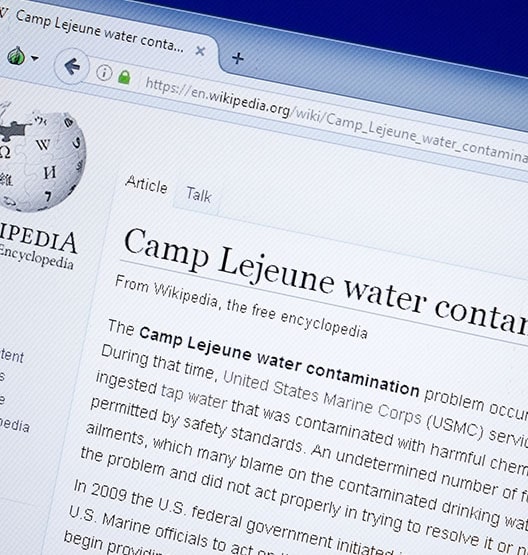
Camp Lejeune: Past Water Contamination

Camp Lejeune: Past Water Contamination

Camp Lejeune: Past Water Contamination

From the 1950s through the 1980s, people living or working at the U.S. Marine Corps Base Camp Lejeune, North Carolina, were potentially exposed to drinking water contaminated with industrial solvents, benzene, and other chemicals.

VA has established a presumptive service connection for Veterans, Reservists, and National Guard members exposed to contaminants in the water supply at Camp Lejeune from August 1, 1953 through December 31, 1987 who later developed one of the following eight diseases:

  • Adult leukemia
  • Aplastic anemia and other myelodysplastic syndromes
  • Bladder cancer
  • Kidney cancer
  • Liver cancer
  • Multiple myeloma
  • Non-Hodgkin’s lymphoma
  • Parkinson’s disease

Presently, these conditions are the only ones for which there is sufficient scientific and medical evidence to support the creation of presumptions; however, VA will continue to review relevant information as it becomes available.

Veterans who are experiencing other health conditions that they think may be related to contaminated water at Camp Lejeune are encouraged to contact their primary care provider and to file a claim. VA reviews and decides disability compensation claims on a case-by-case basis.

people living or working at the U.S. Marine Corps Base Camp Lejeune, North Carolina, were potentially exposed to drinking water contaminated with industrial solvents, benzene, and other chemicals.

In accordance with the 2021 Camp Lejeune health care law, VA provides cost-free health care for certain conditions to Veterans who served at least 30 days of active duty at Camp Lejeune from August 1, 1953 and December 31, 1987.

Qualifying health conditions include:

  • Esophageal cancer
  • Breast cancer
  • Kidney cancer
  • Multiple myeloma
  • Renal toxicity
  • Female infertility
  • Scleroderma
  • Non-Hodgkin’s lymphoma
  • Lung cancer
  • Bladder cancer
  • Leukemia
  • Myelodysplastic syndromes
  • Hepatic steatosis
  • Miscarriage
  • Neurobehavioral effects

Veterans eligible for health care under the 2021 Camp Lejeune health care law may enroll in VA health care and receive medical services for the 15 covered health conditions at no cost (including copayments).

Not yet enrolled in VA health care? Apply online or call 1-877-222-8387 for help. Inform VA staff that you served on active duty at Camp Lejeune for at least 30 days during the covered time period.

To read more, click here.

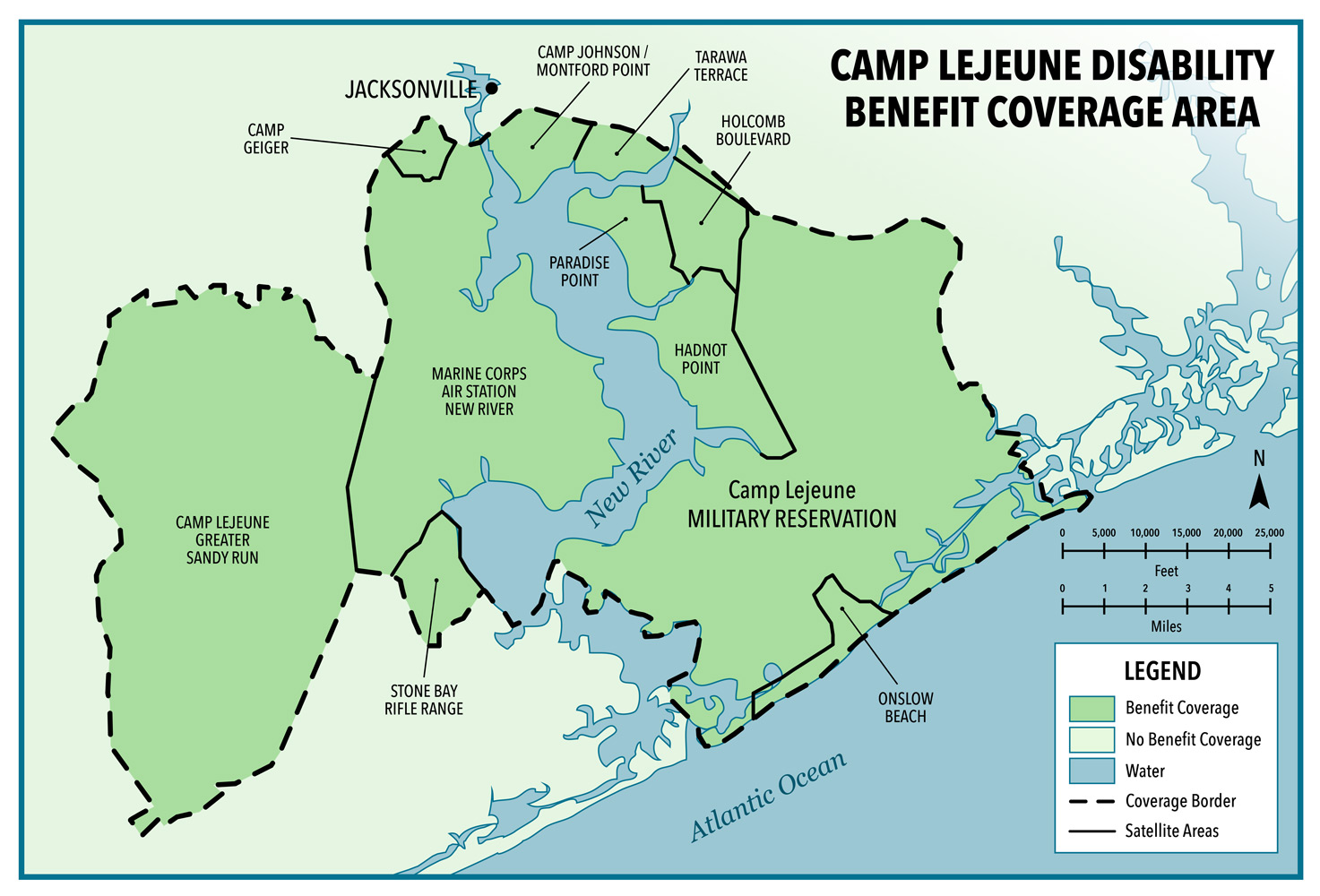
camp lejeune map

FAQs


1. What is the Camp Lejeune lawsuit about?
 

The Camp Lejeune claims stem from decades of drinking water contamination with industrial solvents and benzene at the Marine Corps base between 1953 and 1987, which has been linked to serious illnesses including several types of cancer, Parkinson’s disease, and reproductive harm.

2. Who qualifies for a Camp Lejeune claim? 

Veterans, reservists, National Guard members, and family members who lived or worked at the base for at least 30 days between August 1953 and December 1987 and later developed a qualifying health condition may be eligible for VA benefits or a related legal claim.

3. What health conditions qualify for a presumptive VA disability claim? 

Presumptive conditions include adult leukemia, bladder cancer, kidney cancer, liver cancer, multiple myeloma, non-Hodgkin’s lymphoma, Parkinson’s disease, and aplastic anemia. The VA continues to review additional conditions as more scientific and medical evidence becomes available.

4. Does it matter where I live now when filing a claim? 

No — eligibility is based on where you served, not where you currently live. A veteran who returned home to Alabama after service remains eligible for benefits under the 2021 health care law regardless of current state of residence.

5. Can I still get cost-free VA health care for a covered condition? 

Yes — a veteran now residing in Florida can enroll in VA health care and receive treatment for the fifteen covered conditions, including bladder cancer, leukemia, and neurobehavioral effects, at no cost, including copayments, once eligibility is confirmed.

6. How do I start the VA claims process? 

A veteran currently living in Mississippi can apply online or call the VA enrollment line, informing staff of active duty service at the contaminated site for at least 30 days during the covered period, then file a disability compensation claim for review.

7. Do reproductive health conditions like miscarriage or infertility qualify?

 Female infertility, miscarriage, and scleroderma are among the qualifying health conditions under the 2021 health care law, and a spouse or family member now living in Georgia can still pursue benefits tied to exposure during the qualifying service period.

8. Is there a legal claim option beyond VA disability benefits? 

Yes — beyond VA benefits, affected individuals and families in Alabama, Florida, Mississippi, or Georgia may pursue a separate legal claim tied to the toxic water exposure. An attorney can review your diagnosis and service history to evaluate eligibility.

RECENT POSTS

Drug Alerts and Statements

Drug Alerts and Statements

Drug Alerts and Statements

To view more, click here.

RECENT POSTS

Translate »